10 Popular Poems That Will Ignite Your Happiness
From Despair to Delight: 10 Powerful Poems That Will Ignite Your Happiness
Poetry has a special way of expressing feelings. Happy poems can lift your spirits and brighten your day. They remind you of life’s joys, big and small.
Reading poems about happiness can boost your mood and outlook. From simple pleasures to deep joy, these poems capture different kinds of happiness.
Let’s look at some of the best happy poems ever written.


Save what you love, hover or tap the image and pin it now.
Understanding the Essence of Happiness in a Simple Poem
Poetry captures joy through vivid imagery and emotion. Happy poems uplift readers and celebrate life’s simple pleasures.
They remind us to find delight in everyday moments.
The Emotional Impact of Poetry
Happy poems can boost your mood instantly. Their cheerful words and upbeat rhythms create a positive atmosphere.
You might find yourself smiling as you read about sun-drenched meadows or children’s laughter.
Poems about happiness often use bright colors and lively metaphors. These elements help you visualize joyful scenes. The poet’s words can make you feel like you’re right there in the moment.
Reading happy poems can also trigger happy memories. You might recall your own experiences of joy as you connect with the poet’s words.
Get your Freebie


Themes of Joy and Contentment
Happy poems explore many sources of joy. Some focus on nature’s beauty, like blooming flowers or starry nights.
Others celebrate love, friendship, and family bonds.
Many poems find delight in simple pleasures. A cup of tea, a warm breeze, or a child’s smile can be powerful sources of happiness.
Some poets write about inner peace and contentment. These poems remind you to appreciate what you have.
They encourage gratitude for life’s gifts, big and small.

Happy poems often use vivid sensory details. You might almost taste a ripe peach or feel soft grass under your feet as you read.

Save what you love, hover or tap the image and pin it now.
“Ode to Joy” by Friedrich Schiller
Friedrich Schiller’s “Ode to Joy” is a powerful poem about happiness and unity. You might recognize its words from Beethoven’s Ninth Symphony.
The poem speaks of joy as a force that unites all people. It describes how joy can break down barriers and create a sense of brotherhood among everyone.
You’ll find the poem’s message is universal. It extends the feeling of joy to all living things, from the smallest creatures to celestial beings.
When you read “Ode to Joy,” you’ll notice its uplifting tone. The poem calls for embracing millions and spreading love throughout the world.
Schiller’s work became hugely popular when it was first published. It was even set to music over a hundred times before Beethoven’s famous version.
“Happiness” by Jane Kenyon
Jane Kenyon’s poem “Happiness” stands out for its unique take on joy. The poem compares happiness to mysterious travelers and lost relatives, giving it a tangible form.
You might find the poem’s opening lines striking. Kenyon describes happiness as a prodigal son returning home after a long absence.
The poem then shifts, portraying happiness as an uncle you never knew. This uncle flies a single-engine plane and hitchhikes into town, searching for you.
Kenyon’s vivid imagery helps you picture happiness as something concrete. It’s not just a feeling, but a person or event that can surprise you.
The poem reminds you that happiness can appear unexpectedly. It might show up when you least expect it, like a long-lost relative or a stranger at your door.

Save what you love, hover or tap the image and pin it now.
“The Laughing Heart” by Charles Bukowski
Charles Bukowski’s poem “The Laughing Heart” is a powerful reminder to embrace life fully. It encourages you to take control of your own destiny.
The poem tells you not to let your life be “clubbed into dank submission.” Instead, it urges you to be watchful for opportunities and ways out of difficult situations.
Bukowski reminds you that there is always hope. He writes, “there is a light somewhere.” This light may be small, but it’s better than darkness.
The poem celebrates the power of individual lives. It pushes you to resist conforming to societal pressures that might dampen your spirit.
“The Laughing Heart” uses simple language to convey its uplifting message. It’s a brief but impactful piece that can inspire you to find joy in life’s journey.
“I Wandered Lonely as a Cloud” by William Wordsworth
William Wordsworth’s poem “I Wandered Lonely as a Cloud” is a joyful celebration of nature’s beauty.
You’ll find yourself transported to a picturesque scene of daffodils swaying by a lake.
The poem describes how a simple walk can lift your spirits. You can imagine yourself as the speaker, stumbling upon a field of golden flowers. Their dance-like movement in the breeze might make you smile.
Wordsworth wrote this around 1804, inspired by a real walk he took with his sister. The memory of those daffodils stayed with him, bringing happiness long after the event.
You’ll notice how the poem uses simple language to paint a vivid picture. It shows how nature can provide lasting joy, even in your mind’s eye.
Save what you love, hover or tap the image and pin it now.
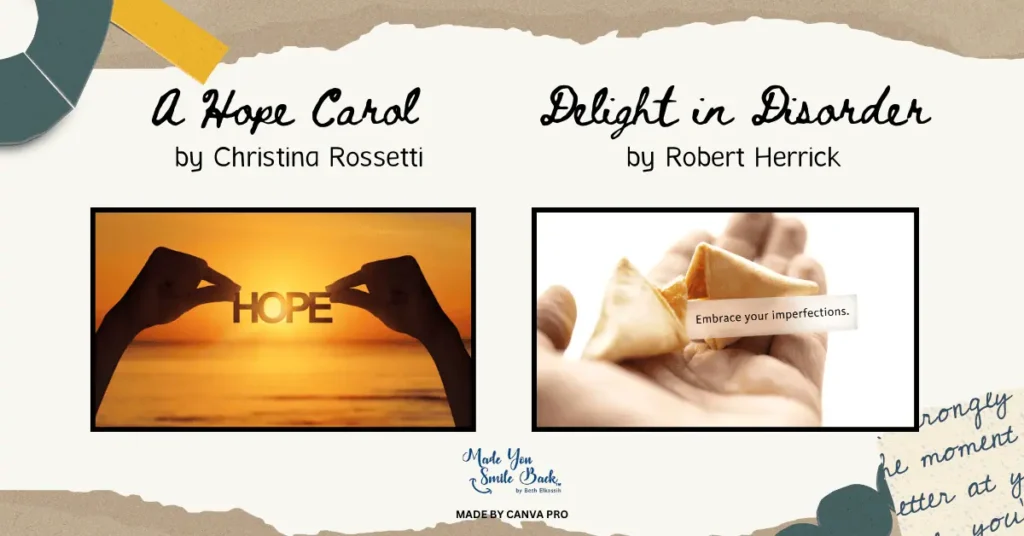
“A Hope Carol” by Christina Rossetti
“A Hope Carol” is a poem by Christina Rossetti that explores themes of spiritual longing and divine revelation. You’ll find it filled with vivid cosmic and mystical imagery.
The poem is structured in four stanzas, each painting a picture of anticipation and hope. You’ll notice Rossetti’s use of repetition, which adds a musical quality to the verses.
As you read, pay attention to the contrast between night and day, which symbolizes the journey from darkness to enlightenment. The sweet voices and wing sounds described create a sense of otherworldly presence.
Rossetti’s work often reflects her deep religious faith. In “A Hope Carol,” you’ll see this through the speaker’s yearning for spiritual connection and understanding.
The poem’s title suggests a message of hope, much like a Christmas carol. As you explore its lines, you’ll find a blend of anticipation and mystery that captures the essence of spiritual seeking.
“Delight in Disorder” by Robert Herrick
Robert Herrick’s poem “Delight in Disorder” celebrates the beauty of imperfection. It was published in 1648 as part of his collection “Hesperides.”
The poem describes how small flaws in a woman’s appearance can be charming. You’ll notice Herrick uses clothing as a metaphor for this idea.
He mentions things like a carelessly thrown shawl or a misplaced ribbon. These details create a sense of spontaneity and natural beauty.
Herrick suggests that too much order can be boring. He prefers a bit of chaos in dress and appearance.
The poem’s structure mirrors its theme. It has a playful, slightly disorderly rhythm that matches the content.
You can see how Herrick’s work reflects the carefree spirit of Cavalier poetry. It values pleasure and beauty over strict rules.
Save what you love, hover or tap the image and pin it now.
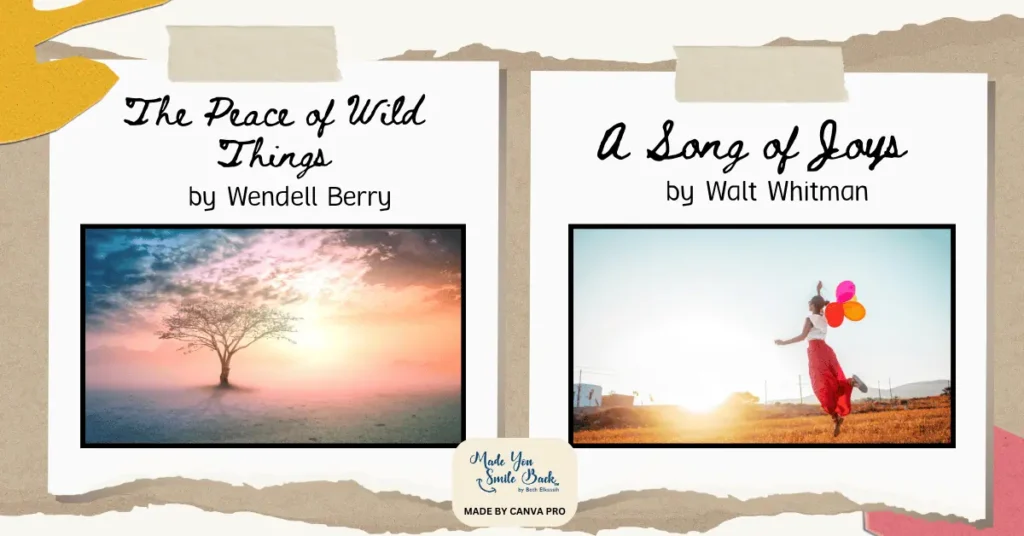
“The Peace of Wild Things” by Wendell Berry
You might find solace in Wendell Berry’s “The Peace of Wild Things.” This widely-loved poem speaks to the healing power of nature.
When anxiety creeps in, the poem suggests you seek comfort in the outdoors.
Picture yourself lying down near a peaceful pond, observing a wood drake and a great heron.
The poem invites you to connect with wild things that don’t worry about the future.
You can find peace in still waters and starry skies.
Berry’s simple language paints a vivid scene. You can almost feel the calm washing over you as you read.
“A Song of Joys” by Walt Whitman
“A Song of Joys” is a celebration of life’s pleasures. In this poem, you’ll find Whitman’s signature free verse style.
The poem explores many sources of joy. You’ll discover happiness in nature, work, and human connections. Whitman’s words paint vivid pictures of everyday delights.
His joy extends beyond the physical world. You’ll see how he finds bliss in both life and death.
This reflects Whitman’s deep connection to all aspects of existence.
The poem’s structure mirrors its theme. You’ll notice long, flowing lines that capture the free spirit of joy. Whitman’s use of repetition adds rhythm and emphasis to his joyful message.
Save what you love, hover or tap the image and pin it now.
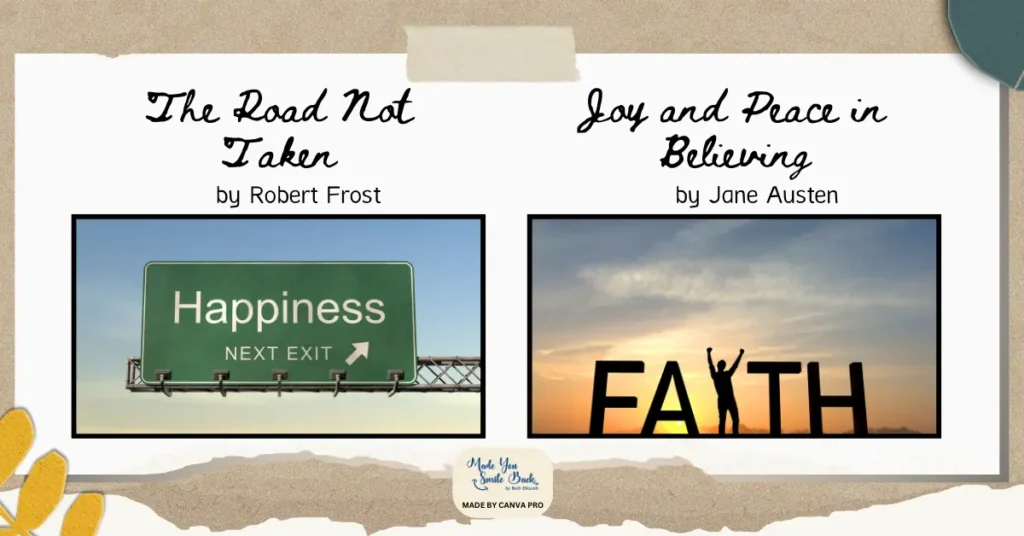
“The Road Not Taken” by Robert Frost
You might be surprised to learn that “The Road Not Taken” is not always a poem about happiness. Many people misinterpret its meaning.
The poem tells of a traveler faced with two paths in a wood. He chooses the less traveled road, seemingly celebrating individuality.
But Frost’s intentions were more complex. The poem may actually be about the human tendency to assign more meaning to past choices than they deserve.
You’ll notice the paths are described as “just as fair” and worn “really about the same.” This suggests the choice wasn’t as significant as the speaker claims.
The poem’s final lines are often quoted out of context. When the speaker says the road “has made all the difference,” it’s unclear if this is positive or simply self-justification.
This widely taught poem encourages you to reflect on your life choices and their impacts.
“Joy and Peace in Believing” by Jane Austen
Jane Austen’s poem “Joy and Peace in Believing” explores the happiness found in faith. You’ll find comfort in her words about trust in a higher power.
The poem describes how belief can bring inner peace. Austen shows how faith can be a source of joy even in hard times.
You’ll notice Austen’s skill in capturing emotions. Her verses paint a picture of the calm that comes from strong beliefs.
As you read, you’ll see how Austen links joy and peace. She suggests that true happiness comes from a sense of spiritual well-being.
The poem reflects themes of comfort often found in religious poetry. You’ll appreciate how Austen expresses these ideas in her unique style.

Save what you love, hover or tap the image and pin it now.
In Conclusion – Final Last Words
Reading poems about happiness can lift your spirits and bring joy to your day. The top poems we explored celebrate life’s simple pleasures and the beauty of the world around us.
Robert Louis Stevenson’s short poem reminds you that the world is full of wonders. Meanwhile, E.E. Cummings expresses gratitude for life’s amazing moments.
Some poems focus on nature’s role in happiness.
Other poets explore different sources of happiness:
- Family and relationships
- Fresh starts and new days
- Inner strength and resilience
These poems offer varied perspectives on happiness.
Remember, poems can inspire you to look for joy in your own life and appreciate the small things that bring a smile to your face.