Chance: How Probability Shapes Decision-Making in Daily Life
🕒 Last Updated on January 23, 2026
When you hear “chance,” maybe luck or randomness comes to mind. Chance is about those unpredictable moments—stuff that just happens, no clear reason or plan behind it.
Getting a handle on chance lets you make better decisions, especially when you can spot the difference between true randomness and patterns you can analyze.
Pop culture is full of chance. Maybe you’ve seen the TV series Chance with Hugh Laurie, where unpredictable situations are the norm.
The show, based on Kem Nunn’s book, weaves together random events in unexpected ways. Or maybe “Chance” means Chance the Rapper to you—he found success by breaking the usual rules of music distribution.
Chance shows up everywhere, from stats class to the choices you make buying groceries or picking a route to work. When you know what’s random and what’s not, you stop falling for weird thinking traps—like seeing meaning in pure chaos or missing real patterns hiding in the noise.


Save what you love, hover or tap the image and pin it now.
Defining Chance: Meaning and Context
Chance is this unpredictable force that nudges outcomes without rhyme or reason. It’s a core idea for explaining all sorts of surprises and possibilities that just pop up, no plan required.
Origins and Etymology
The word “chance” traces back to the Latin “cadere,” meaning “to fall.” Picture dice tumbling in a game—that’s the vibe. The English term “chance” grew from this idea of things happening without design.
Ancient Greeks had “tychē.” Romans said “fortuna.” Cultures everywhere tried to name whatever it was that made life unpredictable.
As language evolved, so did our words for chance. Societies got more complicated, and so did our ways of talking about randomness and probability. It’s clear we’ve always wanted to pin down unpredictable events—even if we never quite succeed.
Get your Freebie


Chance in Everyday Language
You use “chance” all the time. Something happens by chance when it’s totally unexpected—like, “We chanced to meet at the store.”
It also means probability. If you’re talking about the “chances of rain,” you’re really just weighing possibilities.
Games like roulette make it obvious—outcomes are random, not about skill. These games put unpredictability front and center.
How you see chance affects how you handle uncertainty. When the outcome’s unknown, you might start crunching odds, hoping to make a smarter call.
Distinguishing Chance and Luck
Chance and luck? Not quite the same. Chance is neutral—just random events, no opinion. Luck is how you feel about those events: good or bad, helpful or not.

When something works out, it’s “good luck.” When it doesn’t, it’s “bad luck.” Luck adds flavor to the bare facts of chance.
Chance is just part of reality. Luck is your personal spin on it. Some philosophers say chance is out there, objectively, while luck lives in your head—it’s how you frame what happens.
Knowing this difference can help you react to surprises without getting caught up in feelings about them.
Save what you love, hover or tap the image and pin it now.
Chance and Probability: The Mathematical Perspective
Math gives us tools for making sense of chance. Probability theory is where it all comes together. You can use it to analyze uncertainty and sharpen your decision-making skills.
Basic Concepts of Probability
Probability runs from 0 to 1—zero means impossible, one means guaranteed. Everything else is in between.
You run into probability daily, whether you realize it or not:
- Theoretical probability: calculated from all possible outcomes
- Experimental probability: based on what actually happens
- Subjective probability: your personal guess
To get the probability of something, divide the number of ways it can happen by the total number of possible outcomes. So, rolling a 6 on a fair die? That’s 1 out of 6.
Chance events just happen—no one’s pulling the strings. Probability is how we measure and talk about those possibilities with numbers.
Randomness Versus Determinism
Randomness means you can’t predict the outcome, only the odds. Determinism is the opposite—same setup, same result, every time.
Real life usually lands somewhere in the middle. For example:
- Weather systems look random, but they’re driven by physical laws
- Quantum physics? True randomness, at least at the tiniest scales
- Chaos theory says even predictable systems can act wild
When you look at a random event, ask yourself—is it really random, or just too complicated to figure out?
Application in Games and Decision-Making
We use probability all the time, especially when the future’s foggy. Games of chance are the clearest example.
In card games, you can actually calculate your odds. That lets you play smarter, not just by instinct.
Probability also helps with:
- Risk assessment: weighing the odds of something going wrong
- Insurance: setting fair prices based on risk
- Investments: figuring out possible gains and losses
Decision theory mixes probability with value—what’s the expected payoff? Assign numbers to outcomes, do the math, and you get a rational choice (at least on paper).
When you can’t see the future, probability gives you a fighting chance to make sense of it.
Save what you love, hover or tap the image and pin it now.
Chance in Human Experience and Success
Chance shapes our lives in ways we can’t always control. You plan and work hard, but sometimes random events throw everything off—or hand you a lucky break.
Role of Chance in Achieving Success
Success isn’t just about talent. Studies say people try harder when they think they might actually win, not when the odds are stacked against them.
Your career path? It’s probably been nudged by unexpected opportunities. A recent study highlights how much chance matters in career success, even more than we like to admit.
You can boost your odds by setting yourself up for luck. Experts say chance favors open minds, people who read widely, and those who stay curious.
Want to maximize your shot at success?
- Keep preparing—stay ready
- Learn about lots of things
- Be open to surprises
- Spot potential quickly
Influence on Life Events
Chance can flip your life upside down—or right-side up. Meeting your partner, landing your dream job, or stumbling into a new hobby often comes from random encounters.
The circumstances you were born into—where, when, to whom—all of it is a lottery you never entered. That starting point shapes everything else.
Some folks downplay luck to make their story sound better. But admitting luck’s role doesn’t take away from your wins—it just paints a truer picture.
Big shifts—health scares, economic crashes, new tech—can change your trajectory overnight. So much is out of your hands, and that’s a little wild to think about.
Balancing Risk and Opportunity
Knowing the odds helps you make smarter bets. Sometimes, a 50-65% chance is the sweet spot—not too risky, not too safe.
You can up your game by:
- Taking smart risks
- Creating backup plans
- Staying flexible
- Giving yourself more than one way to win
Accepting uncertainty takes guts. Once you let go of the idea of perfect control, you’re free to chase opportunities—even when you don’t have all the answers.
The most successful folks? They don’t just wait for luck—they make sure they’re in the right place if it shows up. Build skills, meet people, and you’ll catch more of those random good breaks (and dodge some of the bad ones).
Save what you love, hover or tap the image and pin it now.
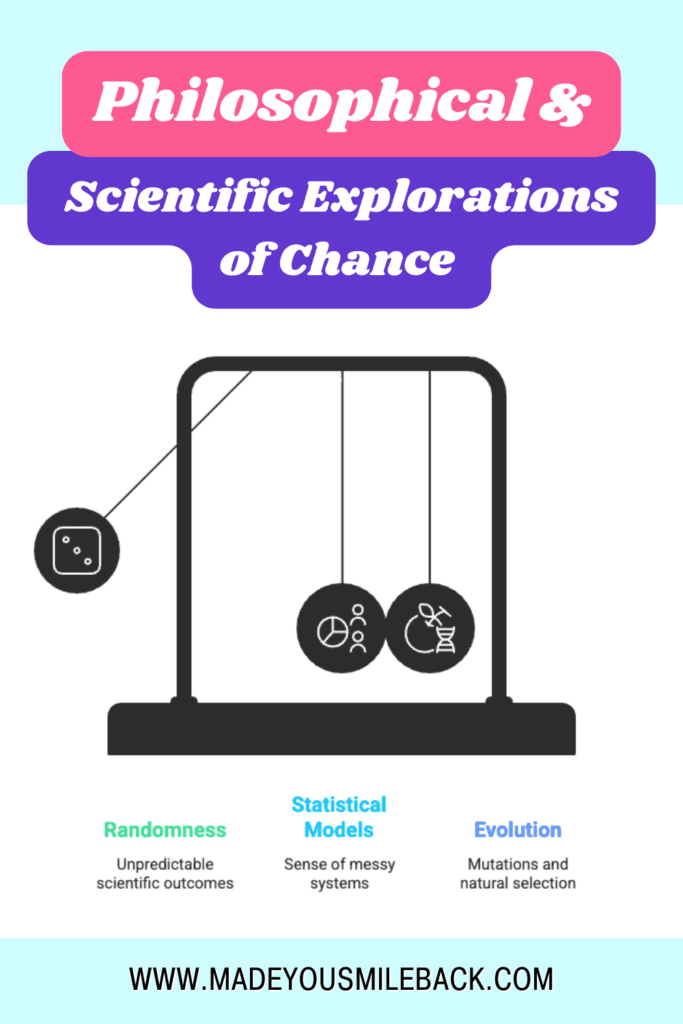
Philosophical and Scientific Explorations of Chance
Chance isn’t just a math thing—it shapes how we see the world. It challenges our ideas about cause and effect in philosophy and science.
Determinism Versus Indeterminism
Determinism says everything has a cause—no room for true randomness. If you think you see chance, maybe you just don’t know all the facts.
When philosophers talk about chance as the opposite of necessity, they’re wrestling with a big question: Is everything predictable, or is randomness baked into the universe?
This debate spills into free will. If everything is determined, are your choices real? Some philosophers find middle ground, saying freedom and determinism can coexist.
Quantum mechanics makes things messier. Down at the smallest scales, particles act randomly—no way to predict exactly what they’ll do. Maybe chance is part of reality itself, not just a gap in our knowledge.
Chance in Scientific Theories
Science leans on probability when things get too complex to predict exactly. You see this in genetics, thermodynamics, and more.
Evolution is a classic case of chance at work. Mutations happen randomly, and then natural selection takes over. Marshall Abrams dives deep into this topic.
Statistical models in science aren’t failures—they’re how we make sense of messy systems. Weather forecasts, for example, use probability because certainty is out of reach.
Randomness in science means outcomes you can’t predict. That’s different from mathematical randomness, which is a whole other can of worms.
Scientists still argue: Is randomness real, or is it just us not knowing enough? That question sits right at the crossroads of philosophy and science.
Save what you love, hover or tap the image and pin it now.
Chance in History and Society
Chance has flipped the script on history more times than we can count. Wars, cultures, and daily life—random events have shaped them all.
Role of Chance in War and Conflict
In war, random twists often matter more than strategy. A sudden storm wrecked the Spanish Armada in 1588, changing history in a night.
Generals talk about the “fog of war”—uncertainty you just can’t plan for. Napoleon wanted to know, “Is he lucky?” because chance can tip the scales.
Sometimes tiny coincidences start huge conflicts. Archduke Ferdinand’s driver made a wrong turn, and boom—World War I.
Tech helps, but even with smart weapons and better info, randomness—broken gear, bad timing, human mistakes—still decides outcomes.
Cultural Interpretations of Chance
Societies see chance and randomness in wildly different ways. The Greeks blamed the gods, while modern cultures use stats and probabilities.
Some cultures love chance—think gambling or rituals. Casinos turn randomness into business. The I Ching uses it for divination.
Religion has its own takes. Some see God’s hand in random events, others talk about karma or fate.
Philosophers and scientists still debate: Is randomness real, or just a sign we don’t know enough? Your culture’s take on chance shapes how you make choices, manage risks, and find meaning in surprises.
Save what you love, hover or tap the image and pin it now.
Notable Figures and Examples Related to Chance
History is full of chance events changing lives, sparking discoveries, and even launching entire movements. Sometimes, a single random moment changes everything.
Fred and the Concept of Chance
Fred Smith, the FedEx founder, is a great example. He pitched overnight delivery in college, got a C, but didn’t quit.
When FedEx was about to go under, Smith took the last $5,000 to Las Vegas. His gamble paid off—he won $27,000, bought the company time, and the rest is history.
Sometimes, luck and guts collide. Smith’s story shows how embracing risk at the right moment can change everything.
Influential Stories Demonstrating Chance
Penicillin? Pure accident. Alexander Fleming came back from vacation and found a mold killing his bacteria—a lucky break that changed medicine forever.
Marilyn Monroe was discovered by chance, too—a photographer spotted her at a factory, and that random encounter launched her career.
Even Google started with a chance meeting between Larry Page and Sergey Brin. So many world-changing ideas start with luck and timing.
Save what you love, hover or tap the image and pin it now.
Frequently Asked Questions
Chance pops up in everything from TV to gaming. Knowing the odds and risks can help you make smarter choices when things are up in the air.
What factors typically lead to the cancellation of television series?
Most shows get canceled because not enough people are watching. Networks watch ratings like hawks—if the numbers dip, the axe falls.
Expensive shows need big audiences to survive. Cheaper ones can hang on with less.
If a network shifts its brand or target audience, shows that don’t fit get dropped, even if they’re doing okay.
Behind-the-scenes drama—fights among cast, writers, or producers—can also end a series fast.
How does one calculate the odds in casino games?
Casino odds are about your chance of losing versus winning. In American roulette, for example, the odds against hitting a number are 37 to 1.
Basic probability? Divide the number of ways to win by total possible outcomes. In probability questions, it’s all about knowing your options.
The house edge is the casino’s built-in advantage—it’s the difference between true odds and what the casino actually pays out.
Some games are better than others. Blackjack, played perfectly, has a tiny house edge. Keno? The house edge can be brutal.
What strategies are most effective for winning at casino games?
Bankroll management is key. Decide what you can lose and don’t cross that line, no matter what.
For games like blackjack or poker, knowing the best moves helps. Memorizing strategy charts can shave the house edge way down.
Take advantage of casino promos—free play, comps, bonuses. They help soften the blow of losses.
Steer clear of high house edge games. Slots, keno, and side bets are usually a losing proposition for strategic players.
In what ways can a television series ending impact its overall narrative?
A solid ending can make a show legendary. Think Breaking Bad—built to a proper finish, and fans loved it.
Rushed endings, usually from sudden cancellation, can ruin a show’s reputation. Writers have to cram too much in, and it rarely works out well.
Open-ended finales let fans fill in the blanks and leave room for a comeback. Sometimes that’s the right move.
If main characters don’t get proper closure, viewers aren’t happy—no matter how good the rest of the story was.
What are common interpretations of chance within philosophical contexts?
Determinists say chance is just us not knowing all the causes. With perfect info, nothing would seem random.
Probability theory gives us a way to talk about uncertainty, but it doesn’t settle whether randomness is real.
Quantum physics throws a wrench in things—at tiny scales, some stuff really does seem random.
Religions often see chance as part of a bigger plan. For some, randomness is just another way the universe works; for others, it’s all guided behind the scenes.
How does the concept of chance influence game design in the Roblox platform?
Roblox games use random number generators to spice things up—loot boxes, enemy spawns, you name it. It keeps gameplay interesting.
Risk and reward systems built on chance keep players coming back. Rare drops with low odds create excitement and drive replay.
Too much randomness feels unfair, too little gets boring. Good Roblox developers find a sweet spot between luck and skill.
Procedural generation lets creators make worlds that change every time you play. Controlled randomness means endless variety without chaos.
Save what you love, hover or tap the image and pin it now.
In Conclusion – Final Last Words
“Chance” pops up everywhere—in books, movies, and life itself. Alice Munro’s short story follows Juliet, a young woman who takes a detour to reconnect with someone she met on a train, even though he’s married.
Munro’s Juliet is always navigating uncertainty, guided by what one critic calls a compass of old legends. That sense of fate shapes her choices.
Joseph Conrad’s “Chance” is another example—a novel that tackles social issues like feminism and financial speculation. Pretty forward-thinking for its time.
In film, “Chance” (2020) tells the story of a 12-year-old baseball player who finds balance and focus through the game, helping him through tough times.
Kem Nunn’s novel introduces Dr. Eldon Chance, a neuropsychologist who keeps getting tangled up in complicated relationships.
Chance—whether it’s fate, luck, or just random opportunity—chance is a powerful force that shapes lives in ways nobody can predict.