
6-Month Challenge to Better Yourself
🕒 Last Updated on March 11, 2025
6 Month Challenge to Better Yourself: Strategic Steps for Personal Growth in 2025
If you’re looking to make a positive change in your life, a 6-month challenge to better yourself may be just what you need. Whether you’re hoping to improve your physical health, mental well-being, or financial situation, setting a goal and committing to it for half a year can be a powerful way to create lasting change.
One of the benefits of a 6-month challenge is that it’s long enough to make a real difference, but short enough to feel achievable. It’s also long enough to build habits that will stick with you beyond the end of the challenge. Whether you’re hoping to improve your fitness, learn a new skill, or save money, committing to six months of consistent effort can help you build the habits you need to continue making progress long after the challenge is over.
If you’re feeling stuck or stagnant in your life, a 6-month challenge can be a great way to shake things up and create momentum toward your goals. By committing to a specific challenge for a set period of time, you can break out of your comfort zone and push yourself to new heights. Whether you’re hoping to lose weight, read more books, or start a new business, a 6-month challenge can be the catalyst you need to make it happen.


Save what you love, hover or tap the image and pin it now.
Understanding the 6 Months Challenge
A 6 month challenge offers a structured framework to transform your life through consistent effort and focused goals. This extended timeframe gives you enough time to make meaningful changes while keeping the endpoint visible.
Key Components of the Challenge:
- Personalized Focus Areas: Choose specific aspects of your life to improve based on your priorities
- Clear Goal Setting: Define measurable targets to track progress
- Structured Planning: Break down your journey into manageable steps
- Consistency: Daily and weekly actions that build momentum
- Progress Tracking: Regular check-ins to evaluate and adjust your approach
Per cosmopolitan mindset case study, many people use this challenge format for their fitness journey or as a comprehensive self-care challenge, but you can customize it to fit your unique needs.
The beauty of dedicating 6 months is that it provides enough time to establish lasting habits. Research shows most habits require at least 66 days to form, so this timeline gives you ample opportunity to solidify several new positive behaviors.
Get your Freebie


Benefits You’ll Experience:
- Breaking unwanted patterns and replacing them with positive routines
- Building resilience as you overcome obstacles
- Developing discipline through consistent action
- Creating sustainable changes rather than quick fixes
The 6 month challenge works because it balances ambitious transformation with practical timeframes. By focusing your energy for half a year, you create enough momentum to push through difficulties while seeing tangible results that motivate continued effort.
Remember that flexibility is important. Your challenge structure should push you beyond comfort while remaining achievable with dedicated effort.
Overall, the six-month challenge is a powerful tool for personal growth and development. It requires effort and commitment, but the results can be life-changing. If you are ready to take on the challenge, start by setting specific goals and creating a plan. With dedication and consistency, you can achieve anything you set your mind to.Set Short-Term Goals to Reach Your Targets
Setting clear goals is key to making real progress in your self-improvement journey. Breaking down your ambitions into manageable short-term targets helps maintain motivation and creates a clear path forward.

Three Areas for Goal Setting:
- Career Development – Set achievable monthly objectives
- Physical Wellness – Track weekly fitness improvements
- Financial Health – Establish concrete saving or debt reduction targets
Creating six-month challenges allows you to focus on meaningful change without feeling overwhelmed. Remember to document your progress regularly to stay accountable and celebrate your wins along the way.
Save what you love, hover or tap the image and pin it now.
Making Your Success Blueprint for Improvement in 6 Months
Nutrition Strategy
A well-planned eating approach is vital for your six-month transformation. Start by evaluating what you currently eat and identify specific areas for improvement.
Weekly Meal Structure:
- Plan 3 meals and 2 snacks daily
- Include at least 3 servings of vegetables in your main meals
- Drink 8-10 glasses of water throughout the day
Create a simple food tracking system to monitor your progress. Many people find success using a basic table format:
| Meal | Protein | Vegetables | Carbs | Fats |
|---|---|---|---|---|
| Breakfast | Eggs | Spinach | Oatmeal | Avocado |
| Lunch | Chicken | Broccoli | Quinoa | Olive oil |
| Dinner | Fish | Mixed greens | Sweet potato | Nuts |
Focus on foods that fuel your body efficiently. Green vegetables help burn fat while providing essential nutrients. Protein supports muscle development and keeps you feeling full longer.
Exercise Routine
Developing a consistent workout schedule is crucial for seeing physical changes within six months.
Weekly workout framework:
- 3-4 strength training sessions (focus on major muscle groups)
- 2-3 cardio sessions (mix high and low intensity)
- 1-2 flexibility/recovery days
Track your max reps for key exercises to measure progress:
- Squats
- Push-ups
- Planks (time)
- Dumbbell curls
Remember that rest days are just as important as workout days. Your muscles need time to recover and grow stronger. Start with manageable goals and gradually increase intensity as your strength improves.
Money Management Framework
Your financial wellness deserves the same structured approach as your physical health.
Create a simple budget using this breakdown:
- 50% for necessities (housing, food, utilities)
- 30% for wants (entertainment, dining out)
- 20% for savings and debt reduction
Priority financial tasks:
- Track all expenses for two weeks to identify spending patterns
- Establish an emergency fund (aim for 3-6 months of expenses)
- Review and reduce unnecessary subscriptions
- Set up automatic transfers to savings accounts
Review your progress every month and adjust as needed. Small, consistent changes to your spending habits can yield significant results over six months.
Consider using a dedicated app or spreadsheet to monitor your financial progress alongside your fitness and nutrition goals. This integrated approach helps you see how improvements in one area often benefit others.
Save what you love, hover or tap the image and pin it now.
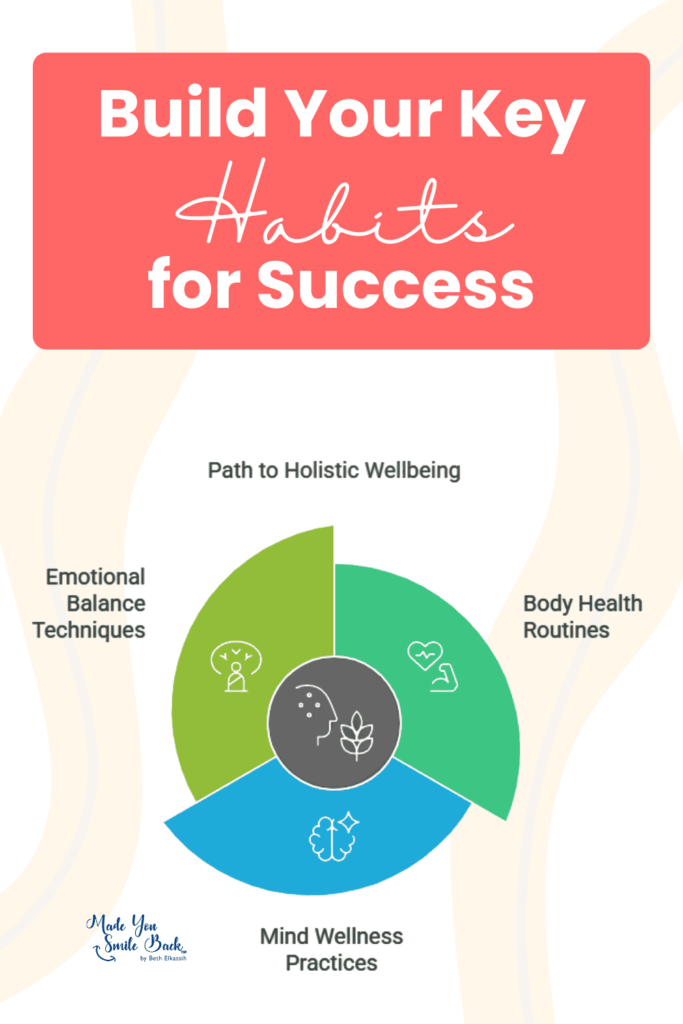
Build Your Key Habits for Success
Body Health Routines
Your physical health forms the foundation for everything else. Start by creating a sustainable exercise plan that fits your lifestyle. Aim for 30 minutes of daily activity, whether it’s a brisk walk, yoga session, or strength training.
Movement Types to Consider:
- Low-impact: Walking, swimming, yoga
- Strength-building: Weights, resistance bands
- Flexibility: Stretching, yoga flows
- Endurance: Cycling, jogging, dancing
Don’t forget to step outside your comfort zone occasionally. Try new activities that challenge your body in different ways to increase flexibility and overall fitness.
Rest is equally important as activity. Ensure you get 7-9 hours of quality sleep each night to allow your body to recover and recharge. Proper hydration (8 glasses of water daily) and balanced nutrition also play crucial roles in your physical wellbeing.
Quick Daily Checklist:
- Moved my body for 30+ minutes
- Drank enough water
- Ate nutritious foods
- Got adequate sleep
Mind Wellness Practices
Your mental clarity directly affects your productivity and happiness. Incorporate mindfulness practices into your daily routine to improve focus and reduce stress.
Start with just 5-10 minutes of meditation each day. Find a quiet spot, close your eyes, and focus on your breathing. This simple practice can dramatically improve your mental state over time.
Taking breaks throughout your day is essential for mental health. Consider the 50/10 method—work for 50 minutes, then take a 10-minute break to rest your mind.
Mental Health Boosters:
- Morning journaling to clear your thoughts
- Midday meditation break
- Digital detox periods (no screens)
- Learning something new weekly
- Spending time in nature
Remember that mental health often requires professional support. Don’t hesitate to reach out to a therapist if you’re struggling.
Emotional Balance Techniques
Your emotional health determines how you handle life’s challenges. Begin by practicing self-awareness—recognize your emotions without judgment.
Set aside time for deliberate self-care activities that fill your emotional tank. This might be reading a book, taking a warm bath, or enjoying a hobby that brings you joy.
Self-Care Ideas:
- Take a short 20-minute nap when energy is low
- Practice gratitude by listing three good things daily
- Connect with a friend or family member
- Engage in creative expression through art or music
Building an accountability system with a partner can help you maintain emotional health habits. Check in with each other regularly to discuss progress and challenges.

Save what you love, hover or tap the image and pin it now.
How to Transform Yourself Through Personal Growth
Boosting Your Daily Output
Want to achieve more each day? Start by creating clear, specific goals. Write down what you need to do each day, week, and month.
Effective Time Management Techniques:
- Break work into 25-minute focus sessions
- Group similar tasks together
- Schedule dedicated time blocks for important work
Creating a distraction-free environment is crucial for your success. Turn off notifications and find a quiet space where you can concentrate.
Remember that developing a daily routine that includes time for your most important tasks will help you stay on track.
Taking short breaks is not a waste of time – it actually helps your brain recharge. Even a 5-minute walk can refresh your mind and increase your output when you return to work.
Strengthening Your Connections
Good relationships don’t happen by accident. They require attention and care. The foundation of any strong relationship is honest communication.
When someone speaks to you, give them your full attention instead of thinking about what you’ll say next.
Ways to show you care:
- Ask meaningful questions about their day
- Remember important dates
- Acknowledge their feelings
When conflicts arise, focus on solving the problem rather than winning the argument. Express your thoughts calmly and be willing to accept accountability for your part.
Don’t forget to tell people how much they mean to you. Small gestures like thank-you notes or unexpected texts can make a big difference in how connected you feel to others.
Building Your Financial Well-being
Taking control of your money starts with knowing where it goes.
Track your spending for a month to identify patterns and areas to improve.
Create a simple budget using this format:
| Category | Planned | Actual |
|---|---|---|
| Housing | ||
| Food | ||
| Savings |
Look for ways to increase your income through side projects or asking for a raise.
Put aside even small amounts regularly. Consistency matters more than the amount when you’re starting out.
Challenge yourself to maintain these new habits for six months. Celebrate your progress along the way, no matter how small the wins might seem.
Save what you love, hover or tap the image and pin it now.
Overcoming Obstacles
Beating Procrastination
Putting things off can sabotage your progress toward self-improvement.
Try these practical approaches to keep momentum:
- Use the 5-minute rule: Commit to just starting a task for 5 minutes—often you’ll continue once you’ve begun
- Break tasks into tiny steps: Instead of “exercise daily,” start with “put on workout clothes”
- Create accountability: Tell a friend about your plans or post your goals on Instagram
Remember to set clear boundaries with your time.
Block specific periods in your calendar for important tasks and treat these appointments as seriously as you would a meeting with someone important.
Bouncing Back from Setbacks
Everyone faces failures on their improvement journey. What matters most is how you respond when things don’t go as planned.
Effective ways to handle setbacks:
- Keep a “lessons learned” journal to track what works and what doesn’t
- Adjust your approach rather than abandoning your goals
- Remember that temporary failures don’t define your overall journey
The most successful people view setbacks as valuable data points rather than personal flaws.
When you focus on execution of your plan, you’ll learn to expect occasional obstacles.
Confronting Your Fears
Fear often appears when you’re making meaningful changes. Here’s how to manage it:
Fear-busting techniques:
- Identify specifically what you’re afraid of (rejection, failure, judgment)
- Take small, calculated risks to build confidence gradually
- Celebrate your courage each time you step outside your comfort zone
Many fears shrink when exposed to action.
As you reimagine yourself and your capabilities, you’ll discover strengths you didn’t know you had.
Transforming Inner Dialogue
The way you speak to yourself dramatically affects your results. Negative self-talk creates invisible barriers to your progress.
Try this approach to change your inner conversation:
| Negative Thought | Improved Alternative |
|---|---|
| “I always mess this up” | “I’m still learning and improving” |
| “This is too hard” | “This is challenging, but I can figure it out step by step” |
| “I don’t have what it takes” | “I’m developing the skills I need” |
When you catch yourself in negative thought patterns, pause and consciously choose a more supportive perspective.
Your mind responds to the questions you ask it—ask better questions like “How can I make progress today?” instead of “Why is this so difficult?”
By creating a daily routine that includes positive self-talk practices, you build mental resilience that helps overcome all other challenges.
Save what you love, hover or tap the image and pin it now.
Adjusting Your Routine to Stay on Track
Staying consistent is the backbone of any six-month improvement plan. Even the best plans need tweaking as you progress through your journey.
- Builds momentum over time
- Creates lasting habits
- Produces measurable results
- Prevents starting over repeatedly
When you notice your consistency slipping, try these practical adjustments:
- Reassess your goals regularly
- Are they still realistic for your current situation?
- Can you break larger goals into smaller chunks?
- Do they need to be modified based on your progress?
- Modify your schedule if needed
- Create a plan that works with your lifestyle
- Adjust timing if certain parts of your day prove difficult
- Build in flexibility for unexpected events
- Improve your tracking system
- Use methods that you’ll actually stick with
- Try apps, journals, or simple checklists
- Make tracking part of your daily routine
- Strengthen accountability measures
- Check if your current accountability partner is helping
- Consider joining a group with similar goals
- Try different approaches like public commitments or rewards
- Focus on actions over outcomes
- Celebrate showing up consistently
- Pay attention to how the process feels
- Acknowledge small improvements

Save what you love, hover or tap the image and pin it now.
Frequently Asked Questions
What daily habits should I include in my 6-month improvement plan?
Small daily actions create big results over time. Consider these effective habits:
- Morning routine: Wake up 30 minutes earlier to meditate, journal, or exercise
- Reading: Dedicate 15-30 minutes daily to personal development books
- Hydration: Drink at least 64 ounces of water daily
- Gratitude practice: List three things you’re thankful for each evening
- Digital detox: Set aside 1-2 hours without screens before bedtime
These simple habits can transform your life when practiced consistently over six months.
How can I structure a 6-month personal growth plan?
A well-designed plan breaks down big goals into manageable monthly themes:
Month 1: Self-reflection and goal setting Month 2: Establish core daily habits Month 3: Focus on physical health improvements Month 4: Develop social connections and communication skills Month 5: Learn new skills aligned with your interests Month 6: Review progress and adjust future goals
This month-by-month approach prevents overwhelm and creates sustainable change.
How do I create a workout routine for my 6-month challenge?
A balanced fitness plan should progress gradually:
Weeks 1-4: Focus on consistency with 2-3 workouts weekly (20-30 minutes each) Weeks 5-12: Increase to 3-4 sessions weekly (30-45 minutes each) Weeks 13-26: Maintain 4-5 sessions weekly (45-60 minutes each)
Include:
- Strength training (2-3 days)
- Cardio (2-3 days)
- Flexibility work (1-2 days)
- Active recovery (1-2 days)
Many successful self-improvers incorporate regular workouts as a foundational habit.
What quotes can inspire me during my 6-month journey?
These powerful quotes can help maintain your motivation:
“Discipline is choosing between what you want now and what you want most.” – Abraham Lincoln
“The only person you should try to be better than is the person you were yesterday.”
“Small disciplines repeated with consistency every day lead to great achievements gained slowly over time.” – John Maxwell
“Success is the sum of small efforts repeated day in and day out.” – Robert Collier
“The harder you work for something, the greater you’ll feel when you achieve it.”
How can I track my progress during this challenge?
Effective progress tracking methods include:
- Weekly check-ins: Review what went well and what needs adjustment
- Monthly assessments: Compare current states to your starting point
- Visual trackers: Use habit tracking apps or wall calendars
- Journal entries: Document thoughts, feelings, and breakthroughs
- Progress photos: Take monthly images for visual comparison
- Metrics: Track relevant data points (weight, savings, skills gained)
Tracking your progress helps maintain accountability and provides motivation when you see your improvements.
What benefits might I experience from a 6-month improvement plan?
Committing to six months of personal growth can yield significant rewards:
- Improved self-discipline: Building consistent habits strengthens willpower
- Greater self-confidence: Achieving goals boosts belief in your abilities
- Enhanced physical health: Regular exercise and better nutrition improve energy
- Stronger relationships: Better communication skills improve connections
- Increased productivity: New habits and systems optimize your time
- Mental clarity: Regular reflection reduces stress and improves focus
- New skills: Dedicated practice develops valuable abilities

Save what you love, hover or tap the image and pin it now.
Taking the Next Steps Forward
Deciding to pursue a 6-month self-improvement challenge marks a significant commitment to your personal growth journey. This decision shows your dedication to creating positive change in your life.
Remember these key points as you move forward:
- Celebrate small wins – Each step forward deserves recognition
- Embrace the journey – Focus on progress, not just end results
- Learn from setbacks – Difficulties often precede your biggest breakthroughs
- Maintain perspective – Growth happens gradually, not overnight
When obstacles arise—and they will—view them as valuable learning opportunities rather than failures. Your resilience through challenging moments will ultimately strengthen your resolve.
Keep tracking your progress in ways that feel meaningful to you:
| Method | Benefit |
|---|---|
| Journal | Records your thoughts and feelings |
| Photos | Provides visual evidence of change |
| Metrics | Offers concrete measurement |
| Check-ins | Maintains accountability |
Don’t hesitate to share your journey with trusted friends or communities. Your experience might inspire others to begin their own improvement path.
Remember that this challenge represents just one chapter in your ongoing story of growth. The habits and insights you gain now will serve you well bCreating a Plan You Need to Ensure Success
When embarking on a 6 Month Challenge to Better Yourself, creating a plan is crucial to your success. A well-structured plan will help you stay on track and achieve your goals. Here are some sub-sections to consider when creating your plan: Diet Plan
A healthy diet is essential to achieving your goals. Start by taking stock of your current eating habits. Identify areas where you can make changes and set achievable goals. Here are some tips to help you create a diet plan:
- Set realistic goals for your diet. For example, you can aim to reduce your sugar intake or increase your vegetable consumption.
- Plan your meals in advance. Use a calendar to map out your meals for the week or month.
- Focus on whole foods that are nutrient-dense and low in calories. Examples include fruits, vegetables, lean protein, and whole grains.
- Keep track of your calorie intake to ensure you’re not overeating.
Workout Plan
Regular exercise is an important part of any 6 Month Challenge to Better Yourself. Here are some tips to help you create a workout plan:
- Set realistic goals for your fitness level. For example, if you’re new to exercise, start with 30 minutes of low-intensity cardio three times a week.
- Mix up your workouts to keep things interesting. Incorporate strength training, cardio, and flexibility exercises into your routine.
- Schedule your workouts in advance. Use a calendar to map out your workouts for the week or month.
- Track your progress to stay motivated.
Financial Plan
A solid financial plan is also important to achieving your goals. Here are some tips to help you create a financial plan:
- Identify your financial goals. For example, you may want to save for a down payment on a house or pay off credit card debt.
- Create a budget that aligns with your goals. Use a spreadsheet to track your income and expenses.
- Look for ways to cut back on expenses. For example, you can reduce your dining out budget or cancel subscriptions you don’t use.
- Set up automatic savings to make it easier to reach your goals.
Remember, creating a plan is just the first step. Stick to your plan and adjust it as needed to achieve your goals. Good luck!
Join in the Conversation
I invite and highly encourage you to share your favorite quotes in the comments below.
About Me – Beth Elkassih, Creator of Made You Smile Back
I love writing quotes and have recently published “365 Unique Quotes – A Year of Uplifting Your Spirit” which is available in all major retail book stores and of course Amazon. You can read more about my Bio here ==> http://madeyousmileback.com/about/


